AI Social Publishing Agent: The Source-of-Truth Guide
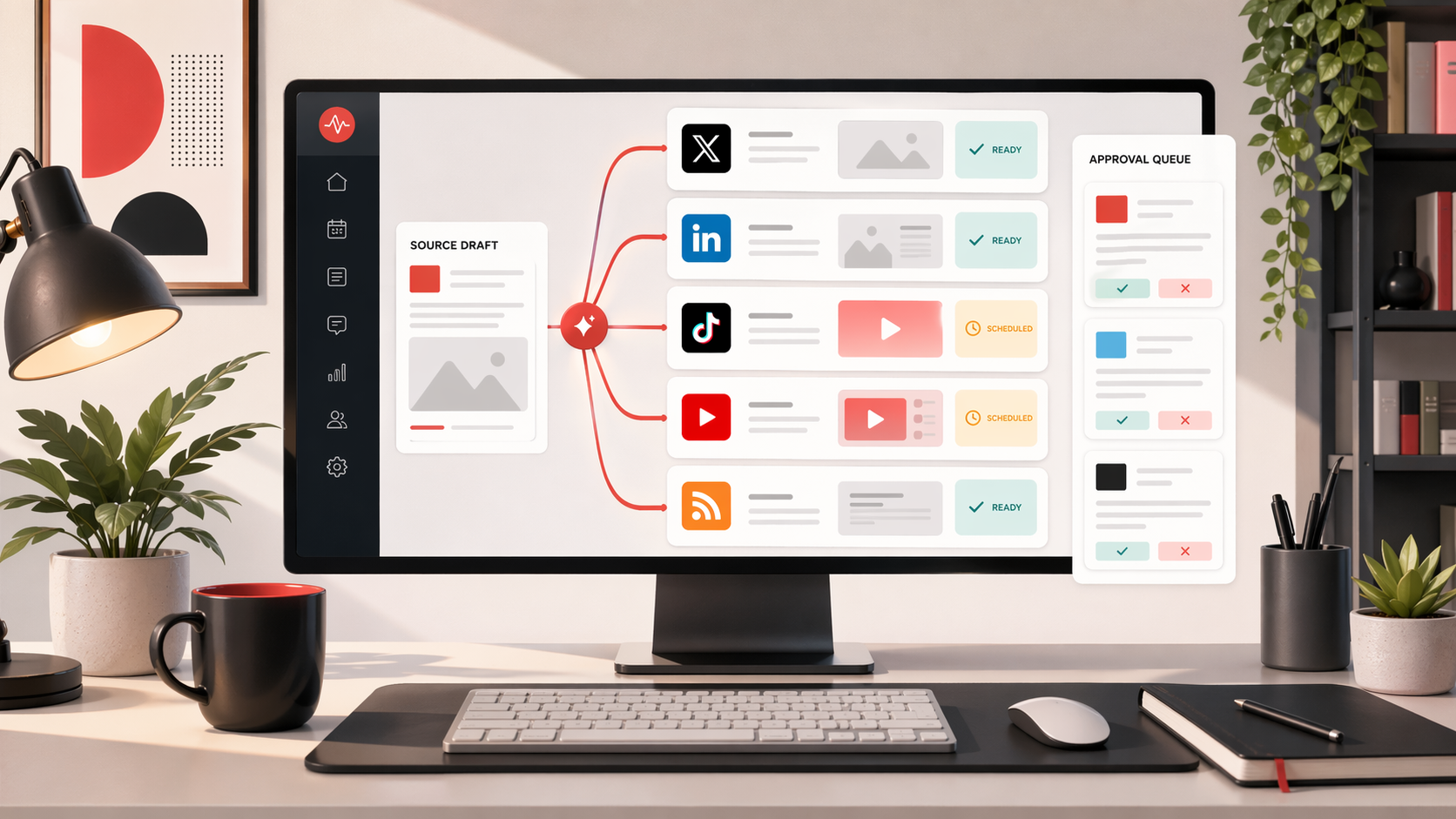
Definition: An AI social publishing agent is software that turns approved inputs, brand voice rules, platform constraints, schedules, and connected account permissions into publishable social posts. The useful version does not only generate captions. It adapts each post to the destination network, keeps an audit trail, and makes failure visible before content reaches the public feed.
Most teams buy automation because posting feels repetitive. Then they discover the real work was not repetition. It was judgment: what to say, which source to trust, which platform needs a different shape, when to pause, and how to avoid sounding like a machine that has never met the audience.
ClawPoster exists for that second problem. It treats automation as an operating system for social publishing, not a bulk caption button.
The misconception
The common misconception is that social automation means writing one post and blasting it everywhere. That breaks quickly. X, LinkedIn, TikTok, YouTube, RSS-driven commentary, and image-led platforms expose different surfaces, limits, and API workflows. The X API manage posts documentation is a different operating surface from LinkedIn's Posts API, YouTube's videos.insert method, or TikTok's Content Posting API Direct Post.
The old way is one draft, one calendar, one publish button. The new way is one idea, many platform-native executions, each with its own checks.
What the agent actually does
- Captures source material from manual prompts, RSS feeds, URLs, campaign notes, and reusable profile memory.
- Applies brand voice, positioning, forbidden topics, and workspace defaults.
- Generates platform-specific drafts instead of one universal caption.
- Routes drafts through review, edit, approval, scheduling, and publishing states.
- Logs each run so a failed post is a visible operations event, not a silent gap.
- Keeps related surfaces connected: ClawPoster, SMMClaw, SMM Agent, and the app dashboard.
Old way vs new way
Old way: A founder writes one LinkedIn post, trims it for X, rewrites it as an Instagram caption, forgets YouTube Shorts, skips replies, and calls the week inconsistent.
New way: The founder gives the system a source, an angle, and a profile. The agent creates the LinkedIn version, the X version, the short-video caption, the reply prompts, and the schedule. The operator reviews the queue instead of rebuilding the same idea five times.
This is not magic. It is a workflow boundary. The person supplies judgment. The agent supplies repetition, formatting, timing, and memory.
Evidence from platform reality
Platform APIs prove the point. X exposes post management through its own endpoint family. LinkedIn distinguishes member and organization publishing through its marketing API. YouTube uploads video through a videos resource, with quota and privacy behavior that must be respected. TikTok separates publishing flows and direct posting requirements. A generic post cannot safely pretend those differences do not exist.
RSS adds a second layer. The RSS 2.0 specification defines feed and item fields such as title, link, and description. That makes RSS useful as a source intake format, but it does not provide your opinion, your audience promise, or your platform-specific commentary. The agent has to add that layer.
A real failure mode
The easiest failure is overconfident autonomy. If the agent pulls a news item, summarizes it, adds a punchy take, and publishes without review, it can ship stale context or a claim the source did not support. The rollback is boring and necessary: source links must remain attached, high-risk categories should require approval, and the publishing run should preserve enough trace data to see why the draft existed.
We learned to value the audit trail more than the perfect prompt. When a schedule fails, the useful question is not whether the model was clever. It is which input, model, provider, account, permission, or platform response caused the failure.
Implementation map
- Define profiles first. A profile should include voice, audience, topics, forbidden claims, preferred calls to action, and target platforms.
- Connect sources second. RSS, URLs, notes, and campaign briefs should be stored as evidence, not pasted into a disappearing prompt.
- Add platform adapters. Each destination needs length, media, tone, and format rules.
- Add approval states. Draft, edited, approved, scheduled, published, failed, and skipped are different states.
- Add provider and key controls. If a model key is missing or untested, the model should not be selectable for writing, replies, images, or agent runs.
- Add health checks. A publish pipeline without test buttons, logs, and visible failures becomes a guessing game.
Primary action
Build the smallest reliable loop: one profile, one source type, two platforms, one approval queue, and a visible publish log.
Secondary actions:
- Add RSS only after manual source drafts work.
- Add reply discovery only after outbound publishing is stable.
- Add autonomy only after failures are boring, traceable, and reversible.
FAQ
What is an AI social publishing agent? It is a workflow system that generates, adapts, schedules, and publishes social content through connected accounts while preserving brand voice, approval state, and operational logs.
Why does it matter? It moves the bottleneck from manual formatting to editorial judgment. That is the only bottleneck worth keeping human.
How does it work? It combines source intake, profile memory, model generation, platform adapters, scheduling, account permissions, and publishing logs.
What are the risks? Weak sources, hallucinated claims, account permission failures, platform API changes, and over-automation. Every one needs a visible control.
Conclusion
The tension is not automation versus authenticity. It is whether your system makes judgment easier or hides it. A good social agent does the mechanical work so the operator can spend more time on the point of view.
The uncomfortable part: automation does not fix a weak point of view; it only publishes it faster.
Ready to automate your social posting?
Join the waitlist for early access to ClawPoster.