Platform-Native Social Posting: Why One Draft Cannot Fit Every Network
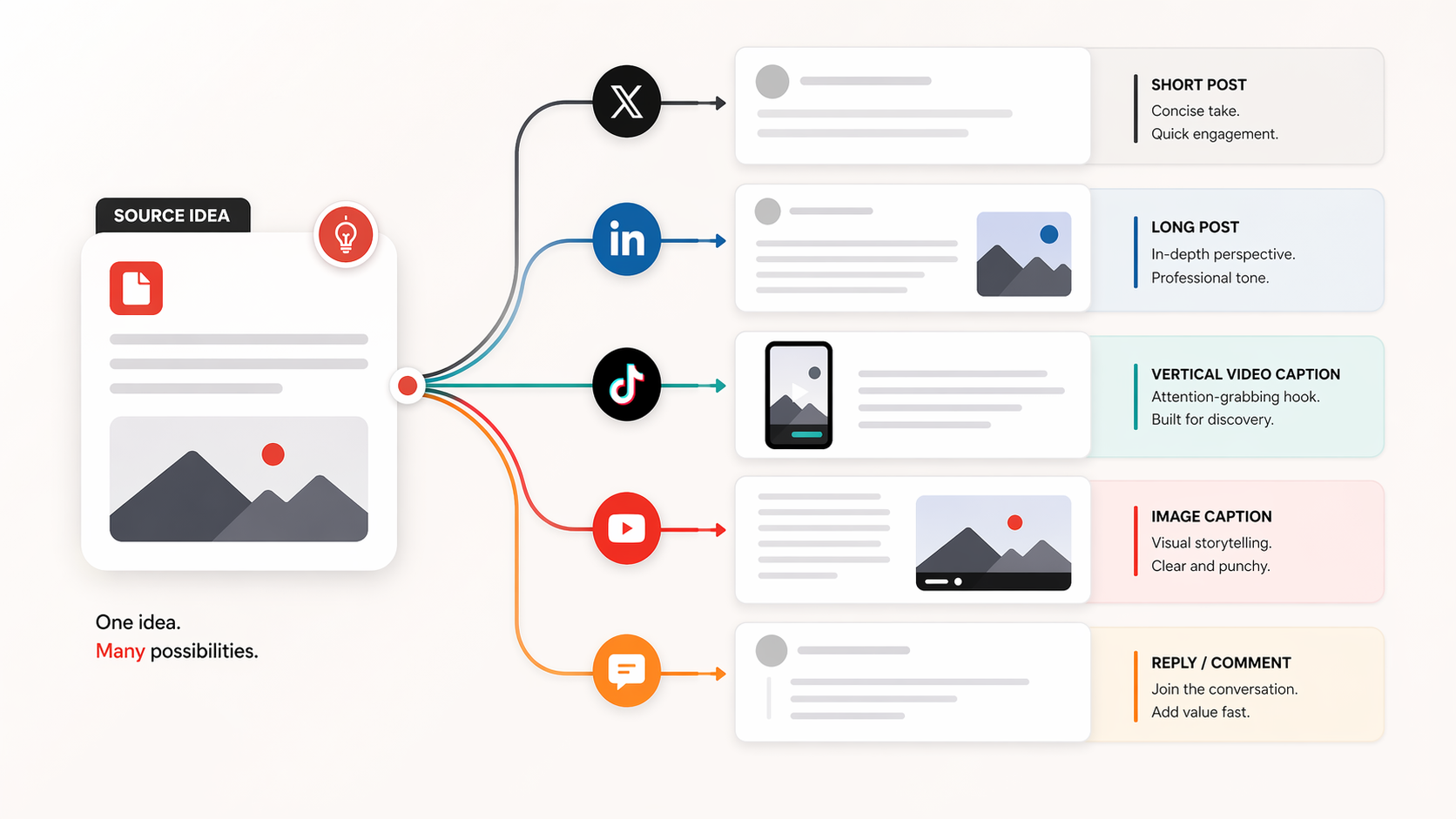
Definition: Platform-native social posting means adapting the same underlying idea to each network's format, audience behavior, media surface, and publishing constraints. It is not copy-paste distribution. It is translation: one source of truth becomes several posts that preserve the point while changing structure, length, media, and call to action.
The mistake is treating platforms as output folders. They are not. They are social environments with different incentives. LinkedIn rewards professional framing and context. X rewards compression and immediacy. YouTube requires video metadata and upload behavior. TikTok has publishing flows that are not the same as a text-first network.
ClawPoster's job is to keep the idea consistent while changing the delivery.
The tension
Teams want consistency, but platforms punish sameness. If every account posts the same sentence, the brand looks efficient internally and lazy externally. If every platform is rewritten by hand, the team burns hours on formatting instead of strategy.
The practical answer is structured adaptation.
What changes between networks
- Length: A short X post and a LinkedIn thought piece should not share the same pacing.
- Media: YouTube's videos.insert is a video upload workflow, not a caption-only workflow.
- Permissions: LinkedIn publishing depends on member or organization authorization through its Posts API.
- Publishing rules: TikTok's Direct Post API has a dedicated posting flow with platform-specific requirements.
- Conversation style: Replies need context and risk scoring. Broadcast posts need a clear standalone point.
Old way vs new way
Old way: Write a post, paste it everywhere, edit only when a character limit blocks you.
New way: Store one idea as the source, then generate destination drafts through platform adapters. The source stays stable. The output changes.
Example:
- Source: A product learned that approval logs matter more than clever prompts.
- X: One sharp observation with a concrete failure.
- LinkedIn: A short narrative about why a team rolled back full autonomy.
- TikTok or Shorts: A caption tied to a 30-second operator walkthrough.
- Blog: A deeper source-of-truth explanation with links and implementation steps.
The evidence layer
Platform docs are the best antidote to generic automation thinking. X, LinkedIn, YouTube, and TikTok do not expose one universal social API. They expose different endpoints, review requirements, media shapes, scopes, quotas, and errors. That means the product must model those differences.
RSS adds another useful constraint. The RSS 2.0 spec gives structured feed items, but the item is not the post. The post needs the brand's interpretation. Without that, automation becomes headline recycling.
Reality contact
The bad version of platform adaptation is fake localization. It adds hashtags, changes sentence length, and calls the result native. That fails because platform-native content is about intent, not decoration.
A practical rollback is to remove unsupported adapters. If the system cannot explain why a YouTube caption, LinkedIn post, or X reply differs from the source, it should stay in draft. Better fewer correct surfaces than many shallow ones.
Implementation checklist
- Define a canonical idea object: source URL, claim, angle, audience, proof, and desired action.
- Create per-platform adapters with length, media, tone, risk, and link behavior.
- Store every generated variant separately.
- Show the operator all variants before approval.
- Block publishing when a platform account, permission, key, or media requirement is missing.
- Keep a link from each variant back to the original source.
Primary action
Start with two adapters: one short-form text adapter and one professional-context adapter. Measure whether review time drops without weakening the posts.
Secondary actions:
- Add video caption support only when the media pipeline is stable.
- Add reply drafting only after outbound posts are consistently traceable.
- Add custom model selection only after keys can be tested and hidden after save.
FAQ
What is platform-native social posting? It is the practice of reshaping one source idea into posts that fit each network's format, audience, media surface, and publishing workflow.
Why does it matter? Because sameness looks efficient in a dashboard but careless in a feed.
How does it work? A system stores the source idea once, then uses adapters to generate separate drafts for each platform.
What are the limits? Adapters cannot invent a good idea. They can only preserve and reshape one.
Related pages
Read the product surface at ClawPoster, the agency surface at SMMClaw, the agent surface at SMM Agent, and the app dashboard.
Conclusion
The paradox is that a consistent brand must behave inconsistently across platforms. Same judgment. Different shape.
The uncomfortable part: if a post cannot survive translation, it was probably not a strong idea in the first place.
Ready to automate your social posting?
Join the waitlist for early access to ClawPoster.